DNA
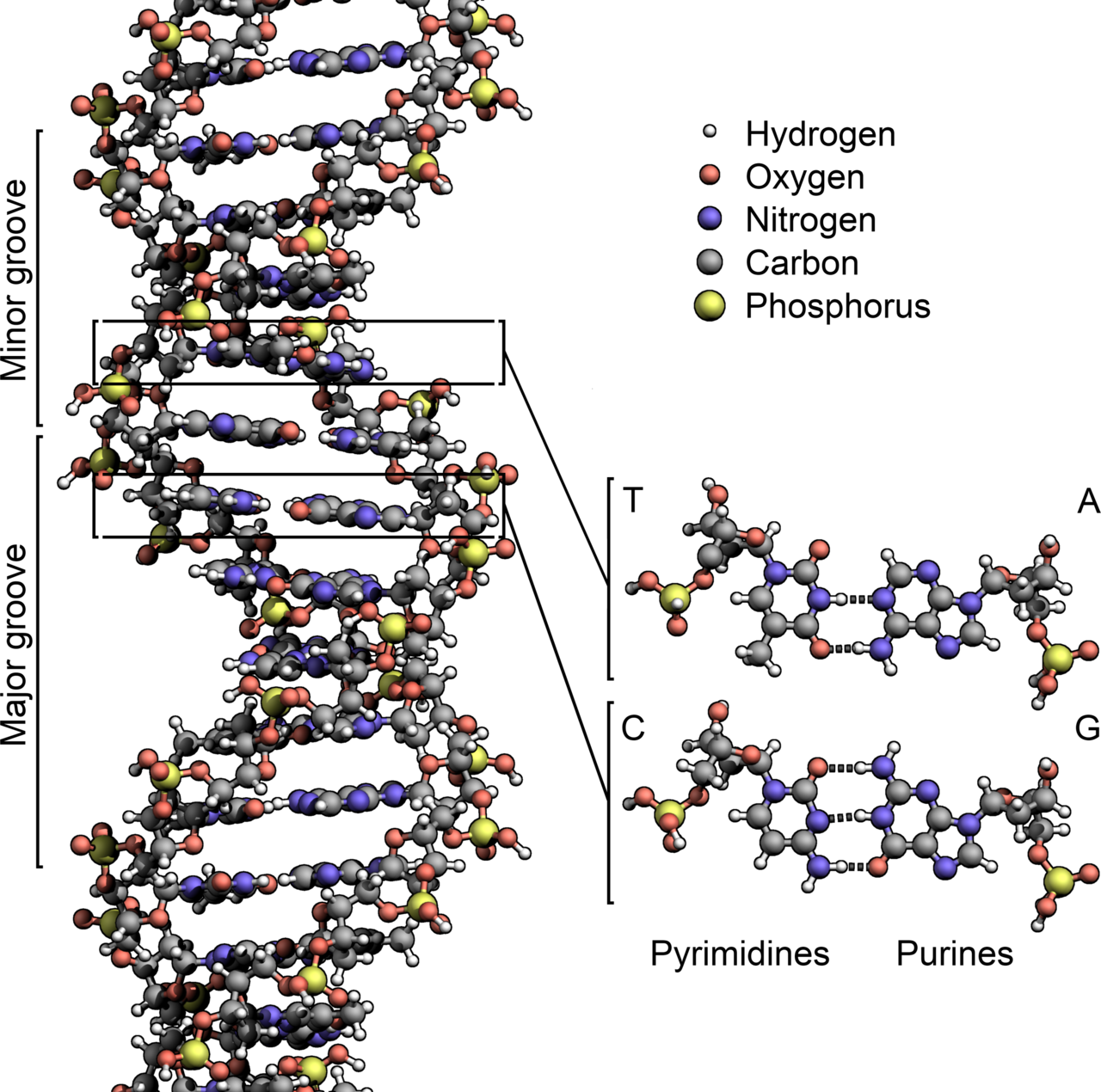
The double helix: antiparallel strands, complementary base pairs, and the sugar-phosphate backbone.
Deoxyribonucleic acid — the molecule that encodes the genetic instructions for all known life and most viruses. A double helix of two antiparallel strands, each a chain of nucleotides (adenine, thymine, guanine, cytosine) bonded to a sugar-phosphate backbone. A pairs with T, G pairs with C.
The human genome: ~3.2 billion base pairs, ~20,000 protein-coding genes, packaged into 23 chromosome pairs. If you unspooled every strand of DNA from a single human cell, it would stretch about 2 metres. The ~37 trillion cells in the human body contain a combined ~74 billion km of DNA.
Central dogma
DNA → (transcription) → RNA → (translation) → Protein
DNA is transcribed into messenger RNA by RNA polymerase. The mRNA travels to the ribosome, where it is translated three bases at a time (codons) into a chain of amino acids. 64 possible codons encode 20 amino acids plus three stop signals.
Replication fidelity
DNA polymerase makes roughly 1 error per 100,000 bases. Proofreading mechanisms reduce this to ~1 per billion. The human genome replicates ~2 trillion times during a lifetime. Even at 1-in-a-billion error rates, that’s a lot of mutations — most harmless, some the engine of evolution, some cancer.
Junk DNA
Only ~1.5% of the human genome codes for proteins. The rest was long dismissed as “junk.” The ENCODE project (2012) suggested ~80% has some biochemical activity. What fraction is functionally significant remains contested — “biochemically active” and “biologically meaningful” are not the same thing.