Natural Selection
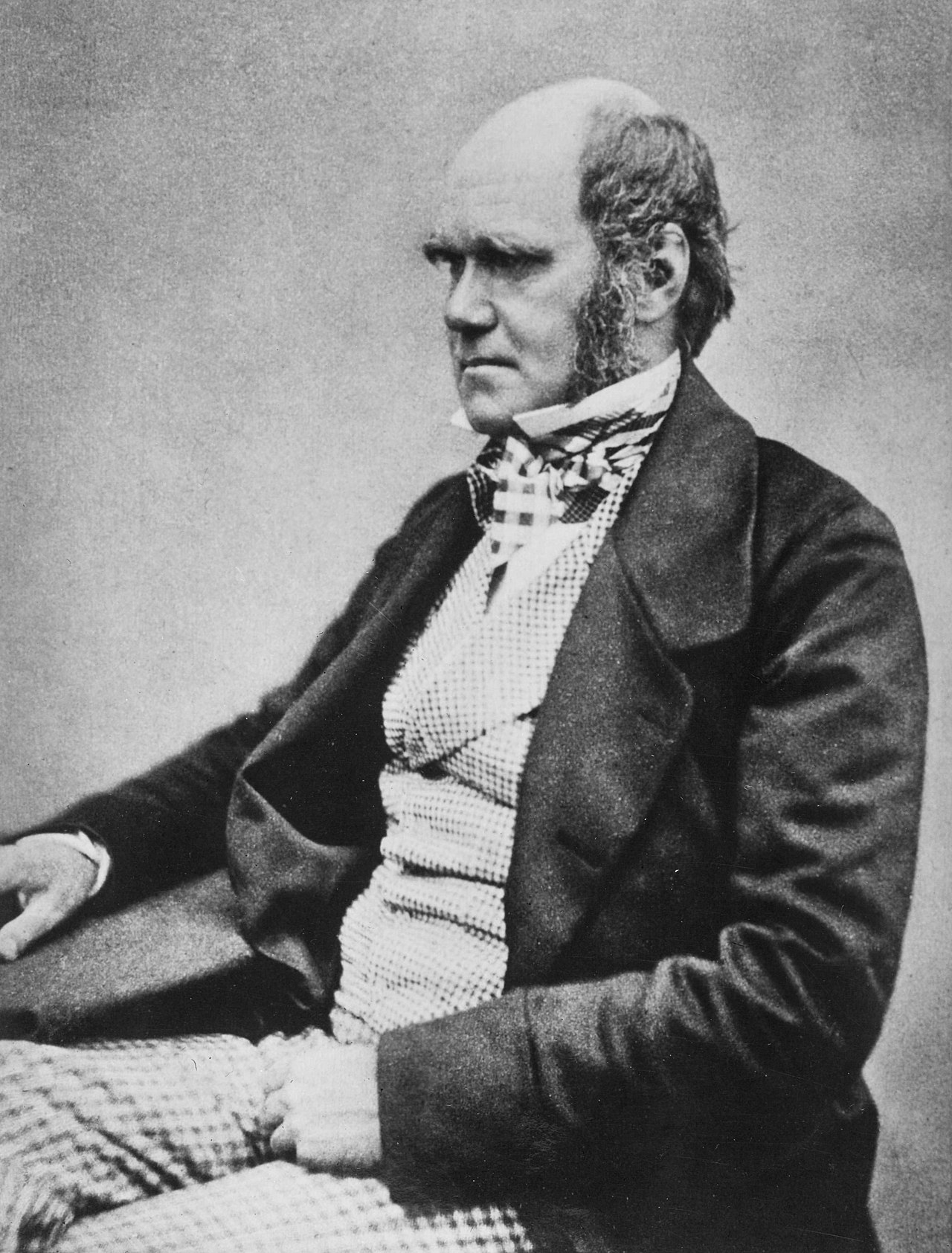
Charles Darwin, who set out natural selection in On the Origin of Species (1859).
Darwin’s mechanism. Four conditions, each necessary, together sufficient to produce evolution:
- Variation — individuals in a population differ from each other
- Heritability — traits are passed from parent to offspring
- Differential reproduction — some variants reproduce more successfully than others
- Selection pressure — the environment favours certain variants
That’s it. No foresight, no goals, no direction. Given enough time and these four conditions, complexity emerges inevitably.
Fitness
“Survival of the fittest” is a summary so misleading it borders on wrong. Fitness in the evolutionary sense means reproductive success — the number of offspring that survive to reproduce. A cheetah that runs 120 km/h but leaves no offspring has zero fitness. A slow tortoise that lives 150 years and mates hundreds of times has very high fitness.
Fitness is always relative to an environment. The same trait that is advantageous in one context is lethal in another.
Levels of selection
Selection acts on:
- Genes — Dawkins’s “selfish gene” view; the gene is the unit of selection
- Organisms — the classical view; individuals compete for resources
- Groups — controversial; groups with cooperative individuals may outcompete groups without them
All three levels operate simultaneously. Most evolutionary biologists weight individual and gene-level selection heaviest; group selection remains debated.
Sexual selection
A special case: traits evolve because they improve mating success rather than survival. Often produces apparently maladaptive structures — the peacock’s tail is a metabolic cost and a predator magnet. The cost is the point: only a genuinely healthy animal can afford it (honest signalling, Zahavian handicap principle).