Special Relativity
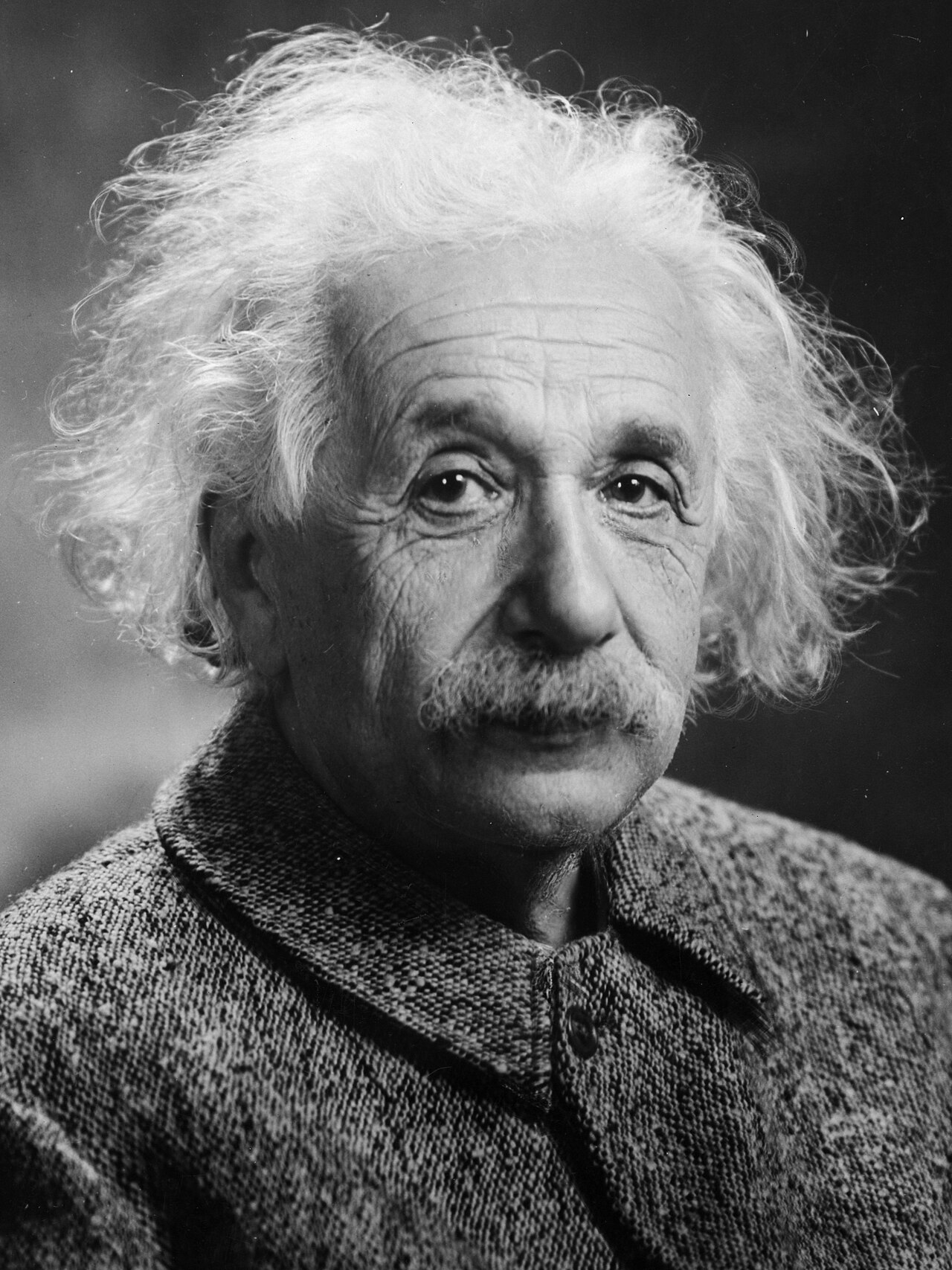
Albert Einstein, who published special relativity in 1905.
Published by Einstein in 1905 in Annalen der Physik. Two postulates:
- The laws of physics are the same in all inertial (non-accelerating) reference frames.
- The speed of light in a vacuum is the same for all observers, regardless of the motion of the source or the observer.
From these two postulates, three deeply counterintuitive consequences follow with mathematical necessity.
Time dilation
A clock moving relative to you ticks slower. At velocity v:
Δt' = Δt / √(1 − v²/c²)
At 87% of c, time runs at half speed. At 99.5% of c, it runs at 1/10th speed. This is not an illusion or a measurement artifact — it is what clocks physically do. GPS satellites must correct for both special-relativistic time dilation (satellites move fast → clocks slow down ~7 μs/day) and general-relativistic time dilation (less gravity → clocks speed up ~45 μs/day), net correction: ~38 μs/day. Without it, GPS would drift ~10 km/day.
Length contraction
Objects moving relative to you are shorter along the direction of motion:
L' = L × √(1 − v²/c²)
A metre stick moving at 87% of c is half a metre long.
Mass-energy equivalence
E = mc²
Mass and energy are the same thing in different forms. The c² factor is enormous (~9 × 10¹⁶ J/kg), which is why a small amount of mass releases tremendous energy — and why nuclear weapons work.
The invariant interval
While space and time individually are relative (different observers measure different values), the spacetime interval between two events is absolute:
s² = c²Δt² − Δx² − Δy² − Δz²
This is the same for all inertial observers. Spacetime has a geometry; it’s just not Euclidean.